AI Overviews and clicks: how to read the CTR studies
Every major study finds fewer organic clicks when an AI Overview appears, from about 5% to about 60% depending on what was measured. Read the method before the headline.
The short answer
Every major study published so far finds fewer organic clicks when Google shows an AI Overview. The size of the drop ranges from about 5% to about 60%, and most of that spread comes from what each study measured: clicks per visit, CTR per impression, CTR at position one against a forecast or total traffic to a whole site.
Being cited inside the Overview is associated with more clicks than not being cited, though still fewer than when no Overview appears. No study has shown that the citation itself causes the difference.
What did each study measure?
| Study | Published | Sample | Period | What it compares | Headline result |
|---|---|---|---|---|---|
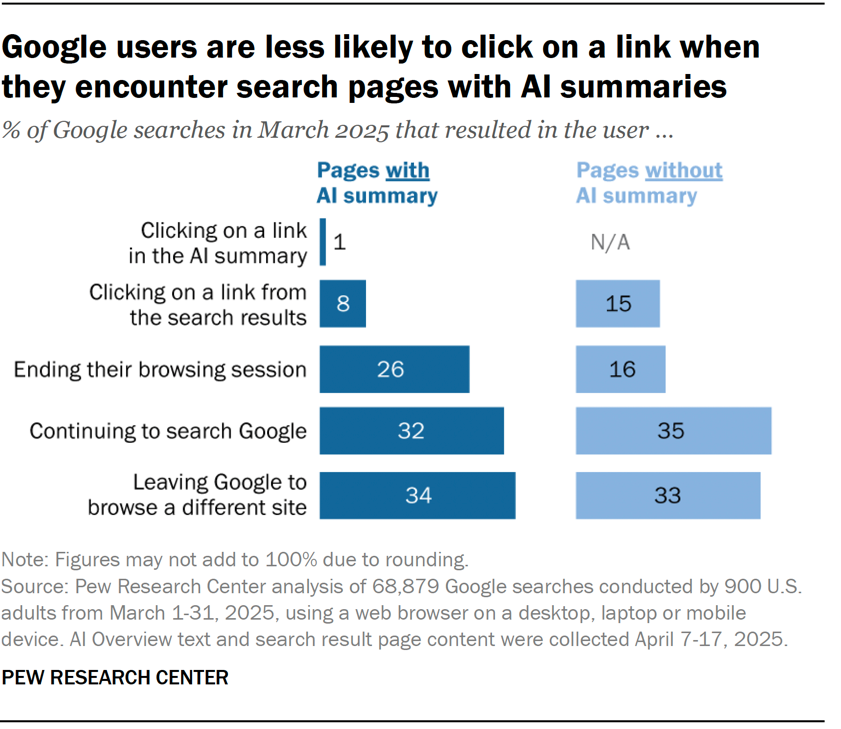
| Pew Research Center | 22 Jul 2025 | 900 US adults, 68,879 searches | Mar 2025 | Visits with a click on a traditional result, with and without an AI summary | 8% with, 15% without |
| Ahrefs | 17 Apr 2025 | 300,000 keywords | Mar 2024 vs Mar 2025 | Position-one desktop CTR against a forecast | 34.5% lower |
| Ahrefs (update) | 4 Feb 2026 | 300,000 keywords | Dec 2023 vs Dec 2025 | Same method | 58% lower |
| Amsive | 16 Apr 2025 | 700,000 keywords on 10 sites; 10,000 that triggered an Overview | Not stated | CTR change on keywords that trigger an Overview | 15.49% lower on average |
| Advanced Web Ranking | 9 Sep 2025 | Thousands of sites, millions of keywords | Q1 vs Q2 2025 | CTR change by position, by industry | Overviews on 46.22% of results pages, up from 34.32% |
| Seer Interactive | 4 Nov 2025 | 3,119 queries, 42 organisations | Jun 2024 to Sep 2025 | Organic CTR with and without an Overview | 0.61% with, 1.62% without (Sep 2025) |
| Seer Interactive (2026 update) | 24 Apr 2026 | 53 brands, 5.47M queries, 2.43B organic impressions | Jan 2025 to Feb 2026 | Same, plus cited against not cited | 2.36% with, 3.82% without (Feb 2026) |
| Agarwal and Sen (SSRN working paper) | Apr 2026 | 1,065 desktop Chrome users | Jan to Feb 2026 | Randomised: Overviews hidden or shown | 38% fewer organic clicks |
| Khosravi and Yoganarasimhan (arXiv) | Feb 2026, revised 2 Sep 2026 | English Wikipedia against German and French | Overview rollout | Search referrals, difference-in-differences | About 5% lower |
| Ahrefs France | 16 Sep 2026 | 963 French domains | 28 days before and 9 days after 22 Jul 2026 | Highly exposed domains against a control group | Median CTR 23.1% lower |
Why do the numbers differ so much?
Because the studies answer different questions. Five differences explain most of the spread.
The unit of measurement. Pew counts the share of visits to a results page that ended in a click on a traditional link. Seer and Amsive divide clicks by impressions across client accounts. Ahrefs looks only at the top-ranking page. The Wikipedia paper measures total search referrals to a site. A 58% fall in position-one CTR and a 5% fall in a site’s total search traffic can both be true at once.
The counterfactual. Ahrefs has no direct comparison group for its Overview keywords, so it forecasts what their CTR would have been by applying the decline seen on informational keywords without an Overview. The result depends on that assumption holding. Pew, Seer and Amsive compare queries with and without an Overview, but those queries differ in other ways too: Pew found that searches of ten words or more produced an AI summary 53% of the time, against 8% for one or two word searches.
Who is in the sample. Seer and Amsive analyse their own clients. Seer’s 2026 update notes that one account made up 47% of the impressions in its informational “Overview present, not cited” group; excluding it raises that group’s CTR from 0.94% to about 1.61%. A single large site can move an aggregate.
The period. The same agency, using the same method, found opposite results in different months. Seer’s 2026 update shows January 2025 organic CTR at 3.19% with an Overview and 2.75% without. By December 2025 it was 1.31% with an Overview and 3.16% without.
Device and intent. Both Ahrefs studies use desktop CTR only. Advanced Web Ranking reported desktop CTR for positions one and two falling by a combined 3.75 percentage points in Q2 2025 while mobile stayed roughly stable.
Which study comes closest to cause and effect?
The randomised experiment by Saharsh Agarwal and Ananya Sen, researchers at the Indian School of Business and Carnegie Mellon University. A Chrome extension randomly assigned 1,065 US desktop users to normal Google Search, Google Search with AI Overviews removed in real time or AI Mode. Each person was followed for two weeks between January and February 2026.
As reported by Search Engine Journal in April 2026, removing the Overview raised outbound organic clicks from 0.38 to 0.61 per search on queries where one appeared, a 38% reduction attributable to the Overview. Zero-click searches rose from 54% to 72%. Survey measures of satisfaction, information quality and ease of finding information were nearly identical between the groups. We could not open the SSRN paper itself, and it is a working paper that has not completed peer review.
The Wikipedia study by Mehrzad Khosravi and Hema Yoganarasimhan uses the staggered geographic rollout of AI Overviews as a natural experiment. Comparing English Wikipedia articles with the same articles in German and French, it estimates that default availability of Overviews cut English Wikipedia’s search traffic by 5.45% and 4.82% in its two main estimates. Wikipedia is an unusual site, so the figure says more about large reference sites than about a typical business.
What does Google say?
Google disputes the framing of these studies but has not published comparable numbers. In August 2025, Liz Reid, Google’s head of Search, wrote that total organic click volume from Google Search to websites had been relatively stable year over year and that Google was sending slightly more quality clicks, where users do not quickly return to the results, than a year earlier. She said third-party reports inaccurately suggest dramatic declines in aggregate traffic, and put this down to flawed methods, isolated examples or traffic changes that predate AI features.
These two positions can both hold. Google talks about total clicks across all queries; the studies measure clicks on the queries that show an Overview. Google has not released the figures behind its statement, so it cannot be checked.
What does the citation effect actually mean?
Seer is the main source here. Its September 2025 update, using Q3 2025 averages, found organic CTR of 0.70% when a brand was cited in the Overview and 0.52% when it was not, which it reports as 35% more organic clicks. Paid CTR showed 91% more clicks when cited.
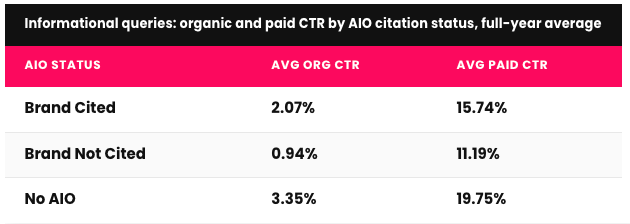
The 2026 update is larger. On informational queries across the year, organic CTR averaged 2.07% when cited, 0.94% when not cited and 3.35% with no Overview. Per million informational impressions, that works out at about 33,500 clicks with no Overview, 20,743 when cited and 9,445 when present but not cited.
Three cautions apply. Seer says it cannot claim causation, because higher-authority brands are also more likely to be cited. The “not cited” figure is pulled down by the single account described above; using Seer’s adjusted 1.61%, the cited group’s advantage shrinks from about 120% to about 29%. And Pew found that only 1% of visits to a page with an AI summary included a click on a link inside the summary itself.
The defensible reading: when an Overview appears, cited pages lose fewer clicks than uncited pages, and both lose clicks compared with results pages that have no Overview.
How should you read the next CTR study?
Ask five questions before quoting it:
- What is the unit: a click per visit, CTR per impression, CTR at one position or total traffic?
- What is the comparison: the same queries over time, different queries at the same time or a randomised control?
- Whose data is it, and could one large account or one industry dominate it?
- Which months, which country and which device?
- Does the author claim causation, and does the design support it?
A new study that answers all five is worth reading closely. One that gives a single percentage without them is a headline.
What to do
- Split your Search Console queries into informational and transactional groups and track CTR for each separately. The informational group is where Overviews appear most.
- Check by hand which of your top informational queries show an Overview and whether you are cited, since Search Console does not separate Overview impressions.
- Compare your own CTR change with the range above. A drop near Ahrefs’ figures on informational queries is consistent with the research; a large drop on transactional queries probably has another cause.
- Work towards being cited on informational queries you cannot afford to lose, while expecting fewer clicks from them either way.
- Measure the value of visits as well as their number: conversions, sign-ups and enquiries from organic search.
- Quote studies with their sample, period and unit, never the headline percentage alone.