Google's August 2026 spam update and what scaled content abuse means for AI-written sites
Google's August 2026 spam update ran from 18 to 21 August with no new policy. For AI-written sites the rule that applies is scaled content abuse: many low-value pages made to rank.
The short answer
Google released the August 2026 spam update on 18 August and marked the rollout complete on 21 August, according to its Search Status Dashboard. It came with no new policy and no blog post. For sites that publish AI-written pages in volume, the policy to read is scaled content abuse, which judges why pages exist and what value they add, whatever tool wrote them.
What did Google announce?
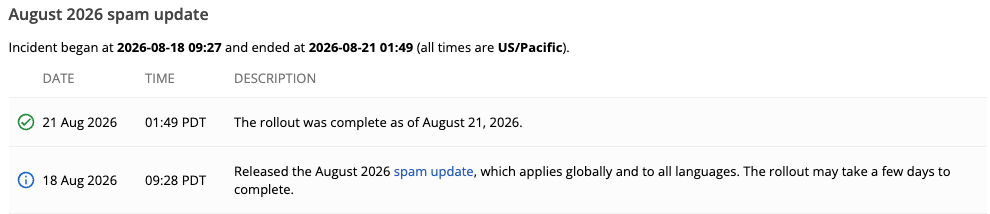
The dashboard lists the incident as “August 2026 spam update” under Ranking. The first entry, at 09:28 US Pacific time on 18 August, says the update “applies globally and to all languages” and that the rollout may take a few days. The second entry, at 01:49 Pacific on 21 August, says the rollout was complete. That is a rollout of about two days and 16 hours.
The entry links to Google’s documentation on spam updates and to nothing else. Google did not name a spam policy this update focused on, and it has not published how many queries were affected.
How does it compare with the other spam updates this year?
It is the third spam update of 2026 on the dashboard, and the longest of the three. Times below are from the dashboard’s incident history.
| Update | Started | Completed | Duration |
|---|---|---|---|
| March 2026 spam update | 24 March | 25 March | about 19.5 hours |
| June 2026 spam update | 24 June | 26 June | about 2 days 1 hour |
| August 2026 spam update | 18 August | 21 August | about 2 days 16 hours |
Two core updates also ran between them, in March and May. A drop that began before 18 August belongs to something else.
What is scaled content abuse?
Google’s spam policies define scaled content abuse as generating many pages mainly to manipulate rankings instead of helping users. The policy says this applies no matter how the content is created. Google’s examples include:
- Using generative AI or similar tools to produce many pages that add no value for users.
- Scraping feeds, search results or other content to make many pages, including through synonym swaps, translation or other automated rewording.
- Stitching content from different pages together without adding value.
- Running several sites to hide how much content is being produced.
- Pages that make little sense to a reader but contain search keywords.
The policy’s own advice for site owners is to exclude such content from Search if they host it.
Is AI-written content against Google’s rules?
No. Google’s February 2023 guidance on AI-generated content says “Appropriate use of AI or automation is not against our guidelines.” The same guidance says that using automation, AI included, with the primary purpose of manipulating rankings is a spam policy violation.
The test is purpose and value. One AI-assisted guide that answers a question with original data is the kind of use the guidance allows. Two hundred AI-written guides that each restate the top results for a keyword fit the first example in the list above.
Which AI-written sites are most exposed?
Google did not say what this update targeted, so nobody can say from public information that a given site was hit by it for scaled content. What the policy text does show is the pattern Google describes as abuse. A site is closer to it when:
- pages are produced from a keyword list faster than anyone could review them;
- most pages summarise what already ranks and add no data, test or first-hand detail;
- the same article is repeated across cities, products or languages with small word changes;
- the site would lose nothing a reader values if half its pages disappeared.
How do you check whether the update affected your site?
Open the Search Console Performance report and compare clicks and impressions for the weeks before 18 August with the days after 21 August. Look at which pages moved. A broad drop across many templated pages points to a sitewide assessment; a drop on a few pages may be ordinary ranking movement.
Spam updates are automated. A manual action would appear separately in the Manual actions report in Search Console.
Google’s spam updates page says sites that see a change should review the spam policies, and that if its automated systems learn over a period of months that a site complies, the site may see improvement. Recovery is measured in months, and Google gives no fixed timeline.
What it means for you
- If you publish with AI, read the scaled content abuse examples and check your site against each one.
- Cut or noindex pages that add nothing beyond what already ranks. Fewer pages with real information are safer than many thin ones.
- Add what a model cannot: your own data, tests, screenshots and decisions with reasons.
- Note 18 to 21 August 2026 in your reporting so later traffic changes are read against the right event.